About the Roaring Fork Outdoor Coalition
Advancing regional collaboration for balanced conservation and recreation
A 2020 Colorado State Executive Order called for collaboration among broad interests to advance a state-level vision for balancing conservation and recreation and to ensure equitable and sustainable access to outdoor recreation. The Regional Partnerships Initiative (RPI) was created to ensure that Colorado remains a world-class outdoor destination while preserving our land, water, wildlife, and quality of life.
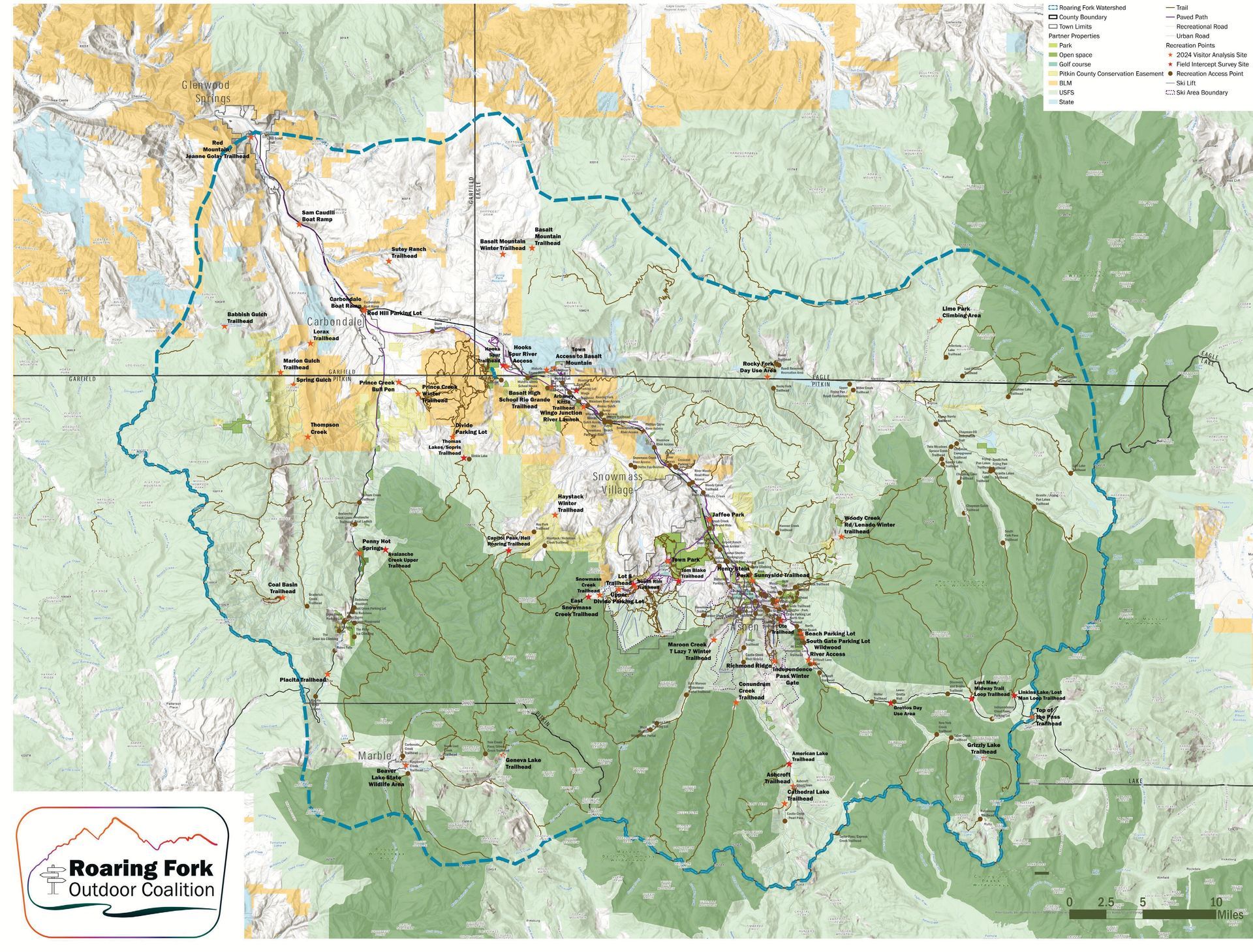
Where We Work
The Roaring Fork Watershed spans approximately 1,500 square miles and includes all of Pitkin County and portions of Eagle and Garfield Counties, and the Crystal River Valley in Gunnison County.
Who We Are
Roaring Fork Outdoor Coalition executive committee
Co-Chairs
Carly O’Connell
Pitkin County Open Space and Trails, Senior Planner & Landscape Architect
Jamie Werner
Eagle County Open Space and Natural Resources, Senior Conservation Project Manager
Emily Seddon (2023-2026)
Eagle County Open Space and Natural Resources, Natural Resources Specialist
U.S. Forest Service
Jennifer Schuller
US Forest Service, Deputy District Ranger
Kendra Head
US Forest Service
Bureau of Land Management
Hilary Boyd
Bureau of Land Management, Assistant Field Manager – Resources
Alan Czepinski
Bureau of Land Management, Outdoor Recreation Planner
Colorado Parks and Wildlife
Matt Yamashita
Colorado Parks and Wildlife, Area Wildlife Manager
Kurtis Tesch
Colorado Parks and Wildlife
City of Glenwood Springs
Dan Roper
City of Glenwood Springs, Parks Superintendent
Pitkin County Open Space and Trails
Gary Tennenbaum
Pitkin County Open Space and Trails, Director
Jessie Young
Pitkin County Open Space and Trails, Planning and Outreach Manager
Liza Mitchell
Pitkin County Open Space and Trails, Natural Resource Manager
Eagle County Open Space and Natural Resources
Marcia Gilles
Eagle County Open Space and Natural Resources, Director
Kallie Rand
Eagle County Open Space and Natural Resources, Natural Resource Manager
City of Aspen Parks and Recreation
Austin Weiss
City of Aspen, Parks and Recreation Director
Matt Kuhn
City of Aspen, Parks and Open Space Director
John Spiess
City of Aspen, Open Space and Natural Resource Manager
Shelly Braudis
City of Aspen, Natural Resource Manager
Town of Snowmass Village
Andy Worline
Town of Snowmass Village, Recreation Director
Kenna Seaward
Town of Snowmass Village
Town of Basalt
Catherine Christoff
Town of Basalt, Town Engineer
Partner Network
To bring priorities to action, the Coalition relies on the staff from area land managers in collaboration with a network of staff from local organizations. Organization involved in implementing the work of the Coalition include: Aspen Chamber Resort Association, Aspen Valley Land Trust, Aspen Center for Environmental Studies, Carbondale Tourism, Forest Conservancy, Independence Pass Foundation, Roaring Fork Conservancy, Roaring Fork Mountain Biking Association, Roaring Fork Outdoor Volunteers, Rocky Mountain Youth Corps, Trust for Public Land, and Wilderness Workshop.
The Stewardship Subcommittee
pilots collaborative approaches and develops coordinated project plans across the watershed.
The Education and Engagement Subcommittee
develops and delivers consistent regional messaging around sustainable recreation and conservation values, ensuring a unified approach to stewardship education from trailheads to classrooms to community events.
Community Advisory Group
Together with the coalition partners, a Community Advisory Group co-developed the watershed-wide strategic plan for conservation and sustainable outdoor recreation, and brought a community perspective to the strategic planning process from 2024 to 2026. The Community Advisory Group is comprised of representation from local non-profit organizations, community groups, and general community members. This 60-member group ensured diverse knowledge and experience was part of shaping our goals and priorities.
Guiding Principles
Core Values
01
The following core values serve as guideposts for decision-making for all representatives of the Coalition.
- We are collaborative, long-standing partners
- We are community-oriented and value relationships
- We believe in access for all and a range of experiences
- We are driven by action for future generations
- We protect our natural resources and environment
- We value and respect others and nature
Vision
02
The Roaring Fork Outdoor Coalition strives to be adaptive to both current and future trends to create an inclusive environment for recreation for all community members while also stewarding conservation-focused values and goals.
Mission
03
The Roaring Fork Outdoor Coalition is a cross-jurisdictional collaboration between state, federal, and local governments in our region. This valley-wide advisory body seeks to bring ideas into action for the benefit of conservation and recreation in our region and pursue funding for projects and programs.
Charter
04
The Coalition makes decisions by consensus. An adopted charter operationalizes our structure and governance.
View the
Final Charter Document
FAQs
What is the Roaring Fork Outdoor Coalition (RFOC)?
The RFOC is a cross jurisdictional collaboration between state, federal and local governments in the Roaring Fork Valley (RFV).
What geographic area does the Coalition focus on?
The RFOC covers the Roaring Fork watershed and surrounding landscapes.
Who participates in the Coalition?
The Coalition is a group of Roaring Fork Valley land managers, cities, towns and counties.
Our History
Why was the Coalition created?
The Roaring Fork Watershed is home to iconic landscapes like the Maroon Bells Wilderness area, Aspen-Snowmass Ski resorts, the “Gold Medal” waters of the Frying Pan and the Roaring Fork Rivers, drawing millions of visitors annually. Yet the region’s ecological health is threatened by overlapping jurisdictions, unmanaged recreation, and changing ecologies that put these beloved landscapes at risk, jeopardizing local economies and the very identity of the region.
Recognizing that no single agency could address these regional challenges alone, Governor Jared Polis issued Executive Order B 2020 008, launching a statewide vision to balance recreation demands and conservation priorities through the Regional Outdoor Partnerships Initiative, working to preserve the state’s land, water, wildlife, and quality of life.
Uniting 14 land managers, 55 partner organizations, and over 950 community members in the Roaring Fork Watershed, the RFOC addresses mounting pressure from rising visitation, development pressures, and habitat fragmentation. Through a shared vision and decision-support toolkit, the RFOC brings together community perspectives that cross jurisdictional and political boundaries. This process celebrates the power of local voices and a regional vision for the protected future of our natural landscapes and communities.
How was plan content developed?
The planning process for the establishment and future operations of the Roaring Fork Coalition was broken down into three funding phases, (1) Establish an Understanding, (2) Build Capacity and Strengthen Partnerships, and lastly (3) Develop a Strategic Plan.
Establish an Understanding. Phase 1 included the initial formation of the RFOC, establishment of a charter as well as significant capacity and partnership building through listening sessions and a valley-wide symposium that brought over 55 partner organizations and 200 community members together to align around shared values.
Build Capacity and Strengthen Partnerships. Phase 2 included the formation of the CAG and a community-wide statistically valid survey to broaden the community’s input and led to the development of the Decisions Support Toolkit, serving as a guide for decision-making.
Develop a Strategic Plan. Phase 3 includes the development of the Strategic Plan through continued involvement from the RFOC and CAG,and bringing ideas to the community in a series of watershed events and final wrap up showcase celebration to build momentum and action for continued efforts.
What role do community members play in the RFOC?
Throughout the process, it was critical to engage residents and partner organizations. At all levels of plan development, engagement cross-checked the direction of the RFOC to develop a plan aligned with community voices. This included listening sessions, a valley-wide symposium, community surveys and a statistically valid survey, and watershed events, engaging over 1,000 residents and partners to have a voice in the planning process.
A Community Advisory Group (CAG) was established in 2025 to bring community perspective, including local non-profit organizations, community groups, and general community members. This 60-member CAG ensures diverse representation from the RFV was part of shaping the goals and priorities for the RFOC.